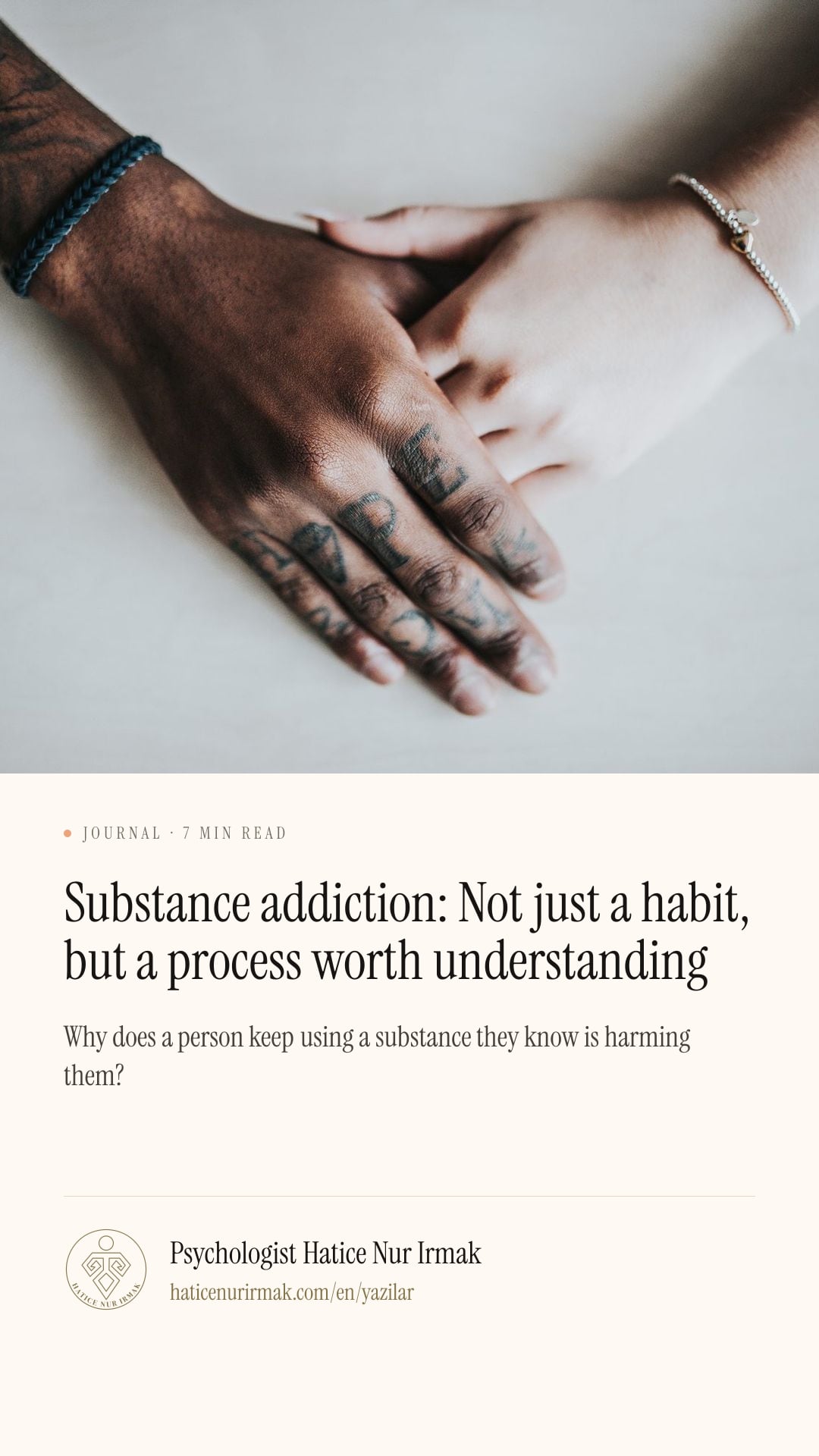
Substance addiction: Not just a habit, but a process worth understanding
Why does a person keep using a substance they know is harming them? A look at the relationship between attachment styles and substance addiction, alongside the findings of our undergraduate thesis project.


When we hear "substance addiction", what often comes to mind is losing control, lacking willpower, or being unable to give up a harmful habit. Yet addiction is not a process simple enough to be understood only through whether someone can or cannot stop using.
Sometimes what we should really be curious about is not so much why a person started, but what place substance use has come to hold in their life. Which feelings it accompanies, in which situations it appears, and what it offers the person in the short term can all be important questions for understanding this process.
Of course, substance addiction cannot be reduced to a single psychological factor. Biological predispositions, environmental conditions, social relationships and life experiences can come together to form a complex picture. But within this multidimensional structure, looking at how a person copes with their emotions and the patterns they develop in relationships can also offer a different perspective.
So could there be a relationship between our attachment styles and substance addiction? How might the way a person builds closeness, trusts others and expresses their emotional needs relate to their experience of substance use?
In our undergraduate thesis research, The Impact of Substance Addiction on Attachment Style, we set out to follow these questions.
Can our attachment style help us understand substance addiction?#
From the earliest years of life, we make sense of ourselves and the world by forming relationships with others. John Bowlby, one of the pioneers of attachment theory, emphasised the importance of early caregiving relationships for a person's sense of security and later relationships.
How our needs were met in childhood, whether someone was there for us when we struggled, and how our feelings were received can, over time, shape the expectations we develop about ourselves, others and relationships.
These experiences also matter for understanding how we live our relationships in adulthood. For example, someone who fears abandonment when they get close and someone who prefers to pull away from others when struggling may not have the same relational experiences.
Two dimensions stand out in understanding adult attachment:
- Attachment anxiety: Worry about the possibility of being rejected, abandoned or not loved enough.
- Attachment avoidance: A tendency to keep one's distance from closeness, from relying on others, or from sharing emotional needs.
These dimensions can help us understand how a person responds in stressful situations and how they cope with emotional needs. But attachment styles are not fixed traits, and they do not determine a person's future on their own.
An important question arises here: when a person experiences difficult emotions, how do they cope with them? Can they share their feelings and seek support, or do they look for other ways to ease their distress for a while?

Can substance use sometimes become a way of coping?#
For some people, substance use may serve to reduce anxiety, suppress loneliness, or get away from distressing thoughts for a while. This does not mean substance use serves the same function for everyone. But understanding what meaning a person attaches to their substance use can help make sense of what they are going through.
Psychiatrist Edward J. Khantzian's self-medication hypothesis suggests that some patterns of substance use may be linked to a person's efforts to cope with emotional distress.

A behaviour bringing short-term relief does not mean it is helpful in the long run. If a person turns to substance use when facing a difficult emotion and then feels temporary relief, that relief can contribute to the same behaviour happening again.
Attachment patterns offer an area worth exploring here, too. How people who struggle to express emotional needs, feel intense anxiety around closeness, or find it hard to trust others cope with stress is among the topics that can be considered when assessing substance use.
But an important distinction must be kept in mind: attachment style on its own is not the cause of substance addiction. Having a particular attachment pattern does not mean a person will develop an addiction. Addiction is a complex process in which biological, psychological and social factors can come together.
What did our research find?#
These questions were also the starting point of our undergraduate thesis project, The Impact of Substance Addiction on Attachment Style.
We examined data from a total of 88 people, drawn from a substance-using group and a control group. To assess attachment dimensions we used the Experiences in Close Relationships Inventory-II (ECR-II), and to assess level of addiction we used the Addiction Profile Index (BAPİ).
Our findings revealed some results worth reflecting on.
In the substance-using group, a moderate positive relationship was found between addiction severity and attachment anxiety (r = .394, p < .01). A positive relationship was also found between addiction severity and attachment avoidance (r = .452, p < .01).
In other words, within the substance-using group in our study, attachment anxiety and avoidance scores tended to rise as addiction severity increased.
However, looking at the study as a whole, we saw that the results could not be reduced to a single explanation.
There was no statistically significant difference in attachment anxiety between the substance-using group and the control group. Nor was there a significant group difference in the distribution of secure and insecure attachment classifications.
Attachment avoidance scores did show a statistically significant difference; contrary to expectations, the control group had higher avoidance scores.
Taken together, these findings suggest that although relationships between addiction severity and attachment dimensions were seen within the substance-using group, the differences between the two groups did not run in the same direction on every dimension.
Factors such as the limited sample size, the characteristics of participants in each group, and the use of self-report measures should be considered when interpreting the results. In addition, our study examines associations; so we cannot say that attachment patterns cause addiction, or that addiction produces a particular attachment style.
The value of scientific research does not always lie in giving definitive answers. Sometimes helping us ask better questions is important in its own right.
Could understanding addiction begin with letting go of judgement?#
When it comes to substance addiction, the conversation is often shaped around willpower, control and responsibility. Yet when we focus only on the behaviour itself, we can miss what function that behaviour serves in a person's life.
Trying to understand which emotions a behaviour is connected to, under which conditions it appears and what it provides in the short term is not the same as approving of it or downplaying its consequences. On the contrary, it can help us assess more fully how change might become possible.
This approach does not remove a person's responsibility. It simply keeps us from reducing them to their behaviour.

In dealing with substance addiction, appropriate professional support, treatment and support from one's social circle can be important. Understanding attachment patterns can also help some people reflect on their relationships, emotional needs and ways of coping. But this is not, on its own, a treatment method or an explanation that applies to everyone.
Perhaps a more meaningful question we can ask ourselves is this: alongside "Why am I still doing this?", to also ask "What need is this behaviour meeting, and how can I meet that need in healthier ways?"
Because understanding substance addiction means looking not only at the substance being used, but also at the circumstances a person is in and the difficulties they are facing. Trying to understand without judging is not ignoring the problem; it opens the door to a more effective and more humane approach.
References#
- Bowlby, J. (1988). A Secure Base: Parent-Child Attachment and Healthy Human Development. Basic Books.
- Flores, P. J. (2004). Addiction as an Attachment Disorder. Jason Aronson.
- Khantzian, E. J. (2003). Understanding addictive vulnerability: An evolving psychodynamic perspective. Neuro-Psychoanalysis.
- Koob, G. F., & Volkow, N. D. (2016). Neurobiology of addiction: A neurocircuitry analysis. The Lancet Psychiatry, 3(8), 760–773.
- Mikulincer, M., & Shaver, P. R. (2013). Attachment in Adulthood: Structure, Dynamics, and Change (2nd ed.). Guilford Press.
Acknowledgements#
This piece draws on our undergraduate thesis research, The Impact of Substance Addiction on Attachment Style.
I would like to thank our advisor, Assoc. Prof. Dr. Gün Pakyürek, for their academic guidance and contributions throughout the research, and my fellow researchers Feride Çörtük, Nida Nur Taşdemir, Sude Tekin and Esma Çelik for their work and contributions.
I hope this piece makes a small contribution to thinking about substance addiction not only as a behaviour, but together with the psychological and social processes behind it.
This piece is for general information; it does not diagnose and does not replace an individual psychological support process.
Share this piece
Vertical image, ready for WhatsApp status and Instagram stories.