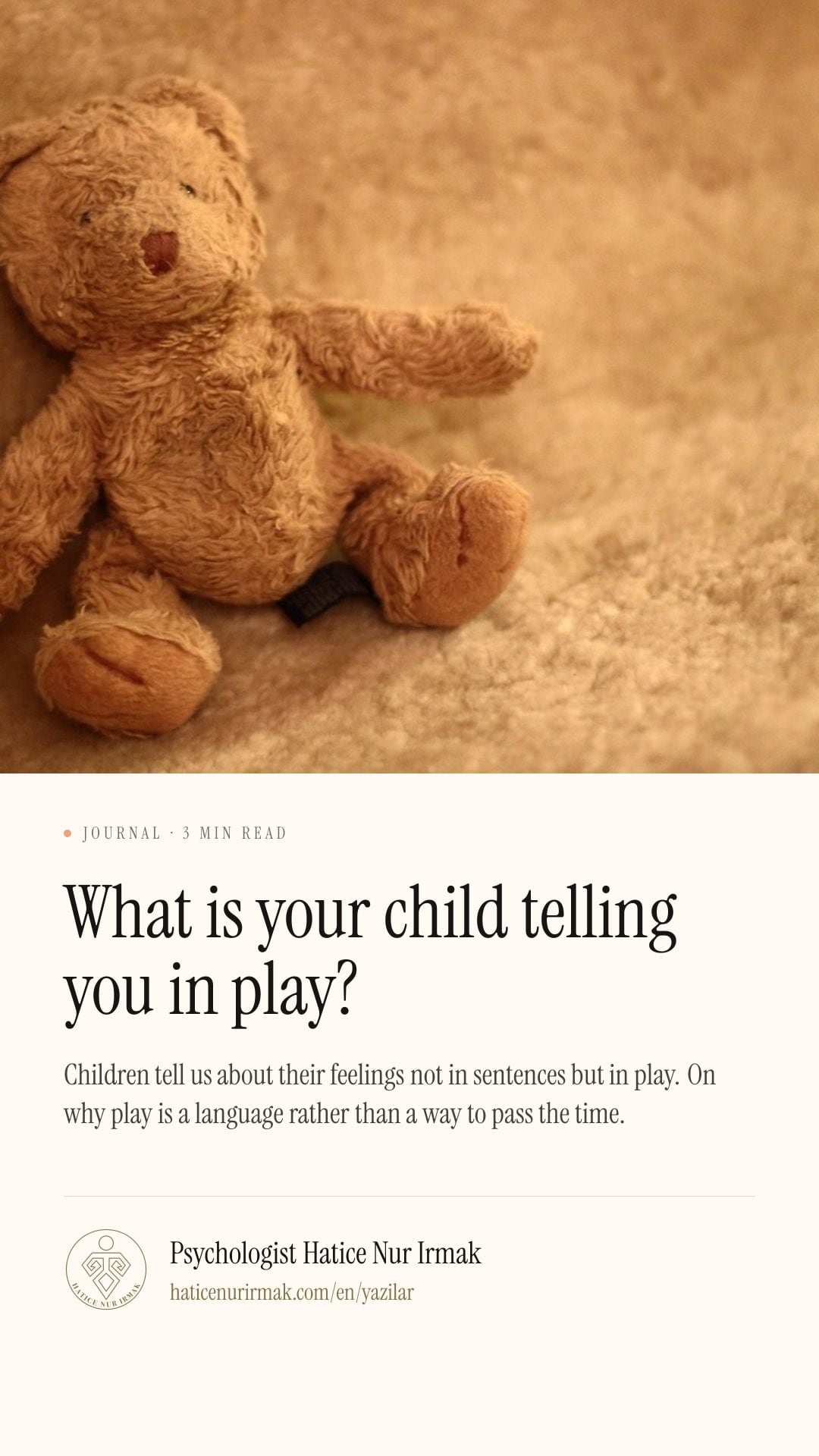
What is your child telling you in play?
Children tell us about their feelings not in sentences but in play. On why play is a language rather than a way to pass the time.


When an adult has a hard day, they can say so: “I'm exhausted, I felt useless today.” For a child, the equivalent of that sentence is usually a game. Building a tower and knocking it down, scolding the doll, repeating the same scene over and over… none of this is random.
Play is a language#
The core assumption of the child-centred approach is this: a child places into play the feeling they cannot yet carry in words. A child who keeps declaring the doll “naughty” after a sibling is born may be telling us about the place they feel they have lost at home. A child who sets up the hospital game again and again may be digesting an operation from last month.
That is why, in the playroom, the child leads. Our task as adults is not to correct the play, direct it or teach the “right” version; it is to accompany, and to name what we see.
Three things you can do at home#
- Fifteen minutes a day of play the child fully directs. Phone away, no suggestions, no questions. Just company. Short but uninterrupted is worth more than long but fragmented.
- Name the feeling, not the behaviour. Instead of “You knocked the tower down,” saying “You got frustrated when the tower didn't turn out the way you wanted” teaches a child that their feeling has a name.
- Take repetition seriously. If the same scene keeps returning for weeks, something is being digested there. Accompanying it patiently usually works better than changing the scene.
A child starts changing their behaviour the moment they feel understood — not the moment we explain.
When is it time to get support?#
Long-lasting regressions in sleep and toilet habits, refusing to go to school, clear difficulty joining peers in play, the intensity and frequency of outbursts… On their own these do not mean a diagnosis; but if they persist, they suggest the child is carrying a weight that is hard to hold.
Work in such a period usually runs along two lines: play-based sessions with the child and regular meetings with the parents. Because a child's recovery mostly moves together with a change in the climate of the home.
This piece is for general information; it does not diagnose and does not replace an individual psychological support process.
Share this piece
Vertical image, ready for WhatsApp status and Instagram stories.